Money review
Bank activity can sit in a review queue with suggested categories. Nothing is written to the books until you or your bookkeeper says okay. A guided walkthrough of the real tools is by arrangement; see our systems.
Public proof. Client books stay private.
These screens are the money gate we actually run: stage the work, suggest where it helps, and a person still has to click approve. The payees and amounts are fake. The approval step is the real method.
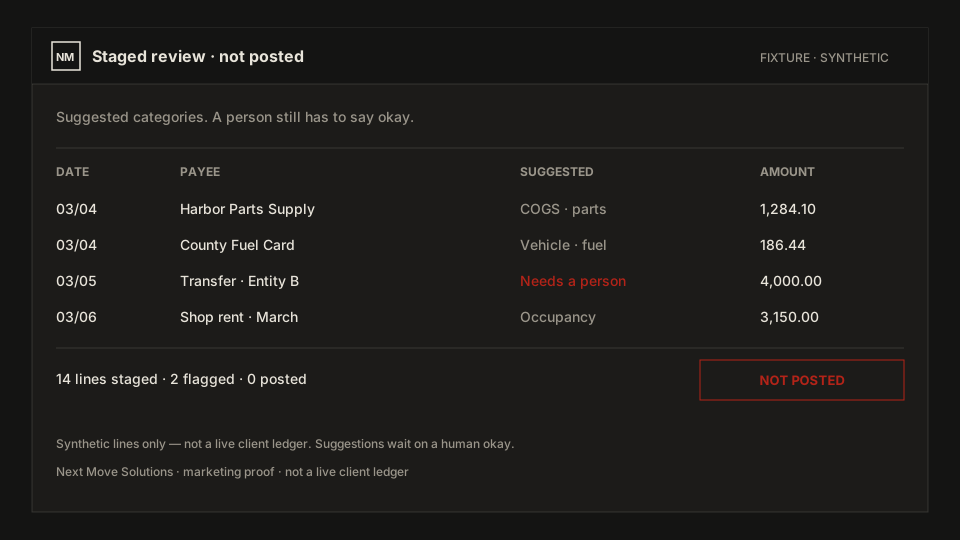
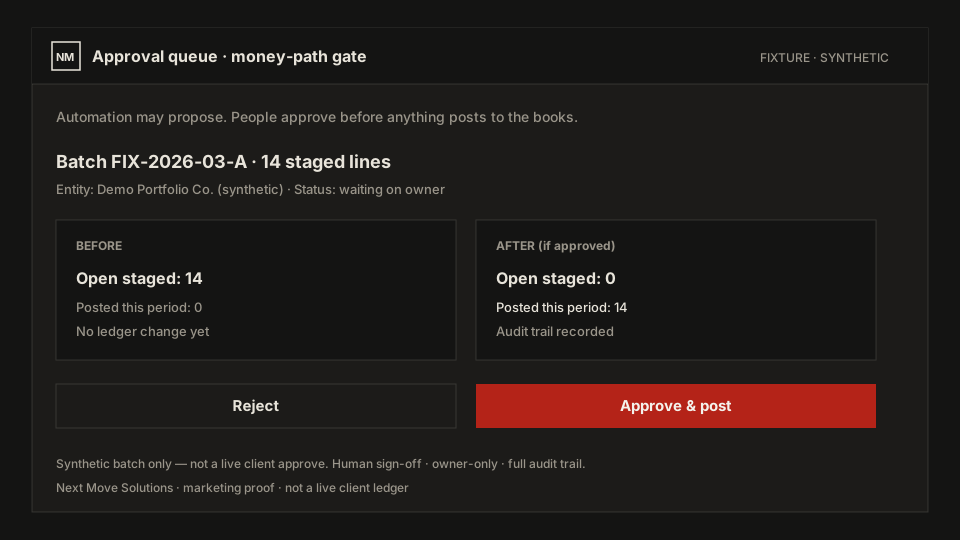
Open the four-step money-side fixture. You will not find a live client ledger here. The EOIR explorer below uses the government’s public case data, not client books.
Bank activity can sit in a review queue with suggested categories. Nothing is written to the books until you or your bookkeeper says okay. A guided walkthrough of the real tools is by arrangement; see our systems.
Jobs, handoffs, and follow-ups should not live in one person’s head. We set up reminders and simple screens the crew will actually open, then train until the crew is still using it next week. See how we work.
The patterns are familiar. Your written statement of work is not a shelf SKU. Deliverables stay written, privacy comes first, and people you trust still make the judgment calls.
Separate from client engagements, we built a public explorer over EOIR’s monthly case-data releases. It’s full-stack work on a messy real-world extract — ingest, models, UI, glossary, and metrics that say what they don’t mean — not a single notebook and not a federal system login.
Open the live explorer at eoir.nextmovesolutions.net. It is running on the public EOIR case-data extract — on the order of 12.7 million distinct cases — not a stand-in and not client books. A deeper walkthrough is by arrangement.
The public ZIP from the fileshare is hashed, unpacked, and stored as Parquet. A smaller sample path exists for local work without hauling the full extract. The public host is the live EOIR explorer.
You can filter cases, open proceedings, and export CSV when you need a slice. The explorer is built for looking, not for over-claiming what the numbers mean.
Definition-first cards name their sources, known biases, and what they do not mean. There are no judge scorecards.
Plain-language terms are tied to the EOIR Policy Manual, so you can read the docket without pretending the numbers are something they are not.
For technical readers, the stack is Python ingest, Parquet, DuckDB, FastAPI, React, TypeScript, and Vite. The explorer is isolated from the firm’s client operations products.
This explorer is public EOIR case data only. That is not negotiable.
The EOIR FOIA case-data ZIP, the agency code key, and the Policy Manual.
Non-public court systems, and client or respondent personal information from practice.
Court-certified statistics, ranking judges, or “best court” scores.
The founder is a former GS-14 Court Administrator at DOJ EOIR, which is systems and docket reality under real rules. See About.
Operators: start at Services or Talk to us about a written engagement.
robert@nextmovesolutions.net · (786) 210-3100